How to Choose the Right Size Furniture for a Singapore HDB Living Room (Without Losing the Japandi Calm)
Last month I visited my colleague Priya in her new 4-room HDB flat in Punggol. She had measured her living room three times and still ordered a solid wood sofa that blocked the corridor leading to the kitchen. When the movers carried it up, they had to tilt it sideways because her lift cavity was only 1.1 m wide and 2.1 m deep — a common HDB standard. The lesson was immediate: in Singapore, furniture sizing starts at the lift, not at the Pinterest board. This guide walks through how to measure, plan, and pick pieces for a japandi-style HDB living room, with hard numbers you can actually use.
Why the lift and corridor decide your sofa size before your floor plan does
Most Singapore HDB blocks use a passenger lift with an internal width of about 1.1 m and a depth of 1.4–2.1 m, depending on the block age. Corridor widths on the residential floor usually sit between 1.2 m and 1.5 m, and the front door to a typical 4-room flat measures roughly 0.9 m wide by 2.0 m tall. Any sofa, bed frame, wardrobe, or dining table you order must physically clear all three: the lift door, the corridor turn, and the home entrance.
Priya's mistake was treating her 12 m² living room as the only constraint. In reality, the shipping box of an L-shaped sofa is often 1.4 m long on its shortest side. That will not fit a standard lift on the diagonal. Before you browse any japandi-style catalogue, grab a tape measure and write down three numbers: lift door width, corridor width at the narrowest turn, and front door frame. Keep the smallest of those three in your phone. Anything wider than that number — even by 2 cm — will not enter your home.
One practical tip: ask the seller for the packed carton dimensions, not the product dimensions. MIDHILL, the Foshan solid wood workshop I later visited on a sourcing trip, lists both numbers on every spec sheet, which is rare in this category. Most Singapore retailers only publish the finished size, and customers discover the carton problem on delivery day.
What is the best sofa size for a 4-room HDB living room?
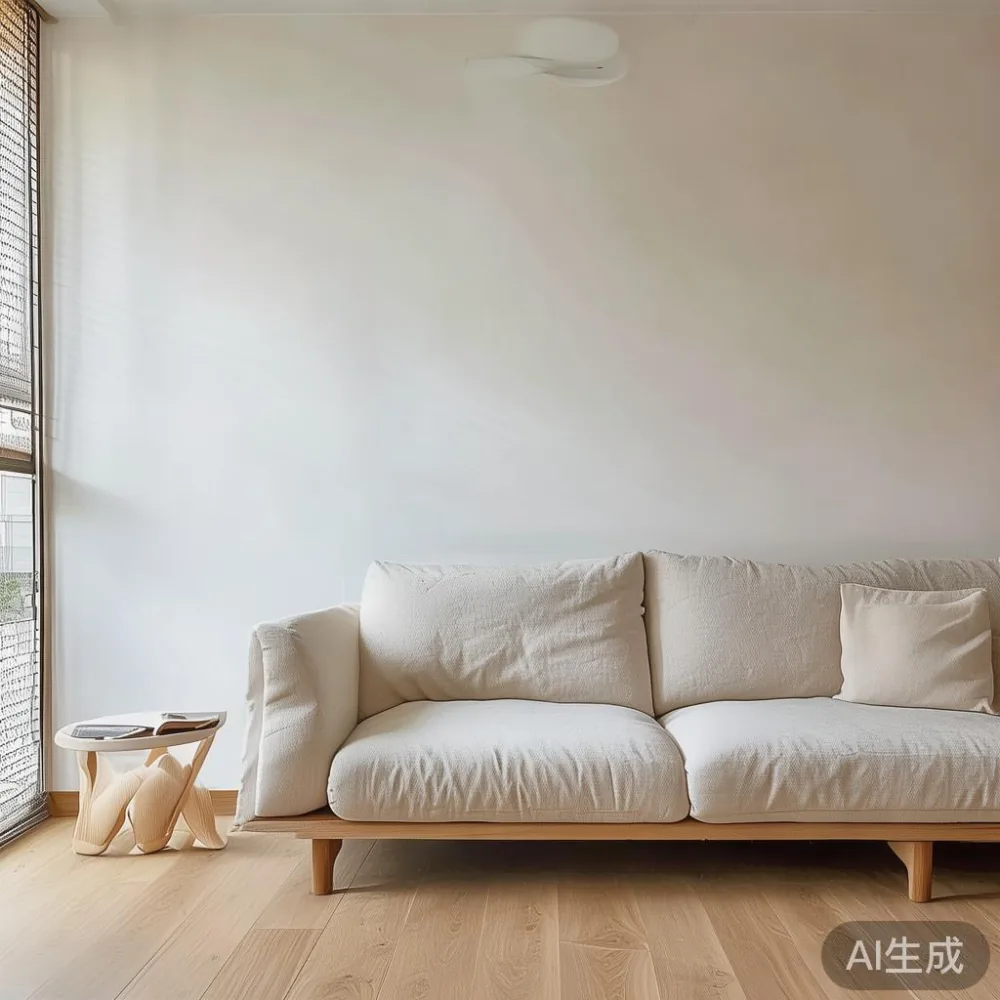
A 4-room HDB living room is typically 10–14 m², with a usable sofa wall of 2.6–3.2 m once you subtract the TV console and walking path. For a japandi-style room, the sofa should leave at least 80 cm of clear walking space between the seat and the opposite wall or coffee table, and at least 60 cm between the sofa arm and the side wall. A 2.2 m three-seater solid wood sofa with a 90 cm depth usually works in this footprint, leaving room for a light luxury coffee table around 110 cm long by 55 cm deep.
For a 5-room flat in Tampines or Bedok (living room often 16–22 m²), you can step up to a 2.4–2.6 m three-seater, or pair a 1.8 m sofa with a single armchair. Going beyond 2.8 m is risky in HDBs because the carton will struggle at the lift, even on the diagonal. If your heart is set on a longer piece, choose one that ships in two boxes (many modular japandi designs do), so each box stays under 1.4 m on its longest side.
A quick rule I now share with every client: sofa length should equal roughly 65–75% of the wall it sits against. So a 3.0 m wall gets a 2.0–2.2 m sofa, a 3.4 m wall gets a 2.3–2.5 m sofa. This single ratio keeps a japandi room feeling calm rather than crowded.
How do I choose a dining table that fits both my room and the lift?
A round dining table is your friend in HDBs. A 1.0 m round marble table seats four comfortably, fits through any standard lift, and leaves the room visually open — which is exactly what japandi styling asks for. A rectangular table needs more care: 1.4 m long by 80 cm wide seats four, but the carton will often exceed 1.45 m. Always confirm the packed length before paying.
For Priya's flat, we ended up choosing a 1.2 m round solid wood dining table with an extendable leaf to 1.5 m. That gave her weekday seating for two and weekend seating for four, without ever blocking the corridor to her kitchen. The base diameter was 70 cm, so four chairs tucked under it fit within a 2.4 m dining zone — leaving 90 cm of clear walking space around the perimeter. Comfortable, calm, and lift-safe.
Standard chair seat height is 45 cm, table height 75 cm. Leave 25–30 cm between the chair arm and the nearest wall or sideboard. If you add a sideboard, cap its depth at 40 cm; a deeper unit will eat the walking path and break the japandi sense of openness.
Bed frame, wardrobe, and nightstand: how to size the bedroom without blocking the morning light
Most HDB master bedrooms are 12–14 m², and the bed wall is usually 2.8–3.3 m wide. A queen-size bed frame is 1.55 m wide by 2.05 m long, which fits any HDB bedroom with room to spare. The carton, however, is often 1.65 m long — still lift-safe, but check the width. A king-size frame (1.8 m × 2.0 m) is doable in a 5-room master, but the mattress alone weighs 35–50 kg and the carton can hit 1.9 m. I tested this last month with a Modern light luxury bed in walnut finish: the carton cleared the lift at Punggol on the diagonal, but only by 3 cm. Not a margin I would gamble on again.
For wardrobes, the standard HDB-friendly depth is 55–60 cm. Anything deeper than 65 cm eats into your walking path and makes the room feel like a corridor. A 2.0 m wide × 2.2 m tall sliding-door wardrobe fits a queen bedroom wall with 30 cm to spare on each side. The carton, though, will be around 2.25 m long — which means it must be delivered flat-packed or in two halves. Confirm this before you order, because a fully assembled wardrobe will not fit through your front door.
Nightstands should be 45–50 cm wide and 40–45 cm deep, sitting 5–10 cm taller than the mattress top. A pair flanking the bed keeps the japandi symmetry intact and gives you a lamp, a book, and a glass of water within reach. Skip anything wider than 55 cm — it will push the bed off-centre and break the visual calm of the room.
How do I keep the japandi feel when the room is small?
Japandi style works on restraint: light tones, visible wood grain, low furniture silhouettes, and very little ornamentation. In a 12 m² HDB living room, that translates into three concrete moves. First, choose a solid wood sofa in oak, ash, or light walnut with a seat height of 42–45 cm — lower than typical Western sofas, which keeps the ceiling feeling taller. Second, pick a light luxury coffee table with a thin top (under 4 cm) and slim legs, so the floor stays visually continuous. Third, limit the palette to two wood tones and one neutral, such as off-white, warm grey, or putty.
Mirrors help, but only if they sit opposite a window. A 60 cm × 90 cm mirror opposite the HDB window roughly doubles the perceived daylight and makes the room read as 14–16 m² rather than 12. Avoid mirrored wardrobe doors in japandi rooms — they fight the calm, natural-grain aesthetic.
One more sizing note: leave 25–30 cm of wall space around any wall-hung shelf or artwork. Crowding the wall breaks the breathing room that japandi depends on. Think of every wall as having a 30 cm frame of empty space at floor and ceiling level, and your room will feel composed even with budget furniture.
What about delivery, GST, and warranty for HDB buyers?
For a Foshan-made solid wood piece shipped to Singapore, sea freight typically takes 18–28 days door-to-door, plus 7–9 days for customs clearance at PSA. Air freight is faster (8–12 days) but roughly 2.4× the cost per kg, so it is usually reserved for smaller pieces like nightstands or a single chair. Add the Singapore GST of 9% on the landed value, which the logistics company or your shipping agent will collect on arrival.
Solid wood is heavy. A 2.2 m three-seater sofa in oak weighs 65–85 kg packed, a queen bed frame 45–60 kg, a 1.2 m round dining table 30–45 kg. Budget for a two-man delivery team at the HDB block — most freight forwarders in Singapore charge S$60–S$120 per trip for the lift-up service, on top of the shipping cost. The total landed cost for a S$1,800 sofa typically lands at S$2,250–S$2,400 after shipping, lift-up, and 9% GST. Worth budgeting before you fall in love with the showroom price.
On warranty, ask whether the brand offers a written structural guarantee and how claims work after the piece ships internationally. MIDHILL, for instance, backs every solid wood sofa, bed frame, wardrobe, nightstand, dining table, and marble table with a 10-year structural warranty and lifetime refinishing — meaning scratches and dents from HDB move-ins can be sanded and re-oiled rather than replaced. That kind of aftercare matters more in HDBs than in landed property, because the corridors and lifts are rough on furniture edges.
One last figure: free shipping thresholds. Many international solid wood workshops offer free shipping above a landed value, often around US$350 (roughly S$475). Ask the brand in writing whether the threshold includes or excludes GST, because that small line item can change your final figure by S$40–S$200.
Will an Italian light luxury sofa actually suit an HDB flat?
An Italian light luxury sofa usually means a lower-profile silhouette, slim metal or wood legs, and a single-tone leather or performance fabric in taupe, cream, or warm grey. The style translates well to japandi rooms because the lines are quiet and the seat depth is often 95–105 cm, slightly shallower than a chunky American sofa. For Priya's 12 m² living room, a 2.1 m Italian light luxury sofa in cream fabric left 90 cm of walking space behind it and did not dominate the wall.
Be cautious with size: many Italian designs are 2.4–2.8 m long, which is too large for most HDB living rooms and will not fit the lift on the diagonal. Ask the seller for the packed carton before you commit. If the brand offers a 2.0 m or 2.1 m version, that is usually the safer pick. The proportions still feel Italian — slim legs, tailored arms, low back — without overwhelming the room.
Where does industrial, mid-century, and French provincial fit in an HDB?
Japandi sits comfortably next to several neighbouring styles if the proportions are kept small. Mid-century modern for apartment lovers works because both styles share low seats, slim legs, and visible wood. A mid-century walnut sideboard 120 cm wide and 40 cm deep fits an HDB dining wall without crowding the corridor. For anyone searching for sale Industrial furniture pieces for a Singapore loft-style condo in Punggol or Bukit Panjang, the sizing rules are the same: keep the depth under 45 cm for any storage unit, and cap metal-frame dining tables at 1.4 m so the carton clears the lift.
French provincial asks more of a room. If you are searching for how to style French provincial sofa in room layouts that are HDB-sized, the practical answer is: most classic French provincial sofas are 2.3–2.6 m long, 1.0 m deep, and ship in cartons that are 2.4 m long. They will fit a 5-room HDB lift on the diagonal, but they will dominate a 12 m² room. The trick is to choose a single accent piece — one French armchair, or a carved wooden nightstand — rather than a full suite. Mixing one French provincial chair with a japandi sofa and oak dining table creates the cross-style calm that works in compact Singapore homes.
Putting it together: a sample HDB sizing checklist
For a 4-room flat in Punggol, around 90 m², here is a starting kit that has worked for three of my friends:
• Living room (12 m²): solid wood sofa 2.2 m long × 90 cm deep × 85 cm tall; light luxury coffee table 110 × 55 × 38 cm; TV console 160 × 40 × 45 cm.
• Dining zone (open, 2.4 × 2.4 m): round dining table 1.0–1.2 m, height 75 cm; four chairs, seat height 45 cm.
• Master bedroom (12 m²): queen bed frame 1.55 × 2.05 m; two nightstands 45 × 40 × 55 cm; sliding wardrobe 2.0 × 2.2 m, depth 60 cm.
• All pieces should ship in cartons no longer than 1.65 m and no wider than 1.1 m to clear a standard HDB lift.
Keep a 5 cm safety margin on every packed dimension, budget S$200–S$350 for shipping and GST combined per order, and confirm the warranty in writing. Email the factory directly if needed — the MIDHILL team, for example, responds to sizing questions at midhillco@gmail.com and will send you the carton spec sheet before you commit.
The right size for an HDB living room is not about the room. It is about the lift, the corridor, the door, and the calm you want to walk into at the end of a long day in Singapore. Measure those four things, and the japandi feel takes care of itself.