Price Dynamics of Solid Wood Furniture: Inside Insights
Solid wood furniture is often described as a simple material choice: oak, walnut, ash, teak, or another timber. In practice, price is shaped by several measurable factors, from the board grade and moisture content to joinery, hardware, dimensions, finish, and delivery logistics. For Singapore households, those details matter because a dining table must clear a corridor and fit into an HDB lift, while a bed frame must suit the dimensions of a Tampines or Bedok flat without compromising stability.

The useful comparison is not merely solid wood versus engineered wood. It is what the maker has done after selecting the timber. A carefully engineered solid wood sofa may cost more than a visually similar model made with lower-grade panels because its frame, suspension, finish, and warranty are designed as one system. Conversely, a plain timber dining table can be expensive because of its thickness, length, and careful surface preparation.
This guide examines the variables that genuinely affect solid wood furniture pricing, including references such as under 2000 French provincial furniture and luxury Italian light luxury furniture. It also considers how japandi style fits compact Singapore interiors, from the solid wood sofa and bed frame to the dining table, wardrobe, nightstand, and occasional marble table.

What makes solid wood furniture expensive?
The timber itself is only one part of the price. Solid wood furniture typically begins with sawn boards that are dried, graded, cut, joined, sanded, and finished. The species influences raw material cost: white oak and American walnut often require more selective sourcing and longer preparation than faster-growing plantation woods. reclaimed timber can introduce another layer of cost because each board must be inspected, cleaned, and matched for colour.
Board grade is equally important. “Solid wood” does not specify whether every visible surface uses clear-grade boards, whether knots and mineral streaks are controlled, or how much variation the customer should expect. A table with book-matched boards and restrained figuring demands more attention than one intended to have a rustic appearance. Grain direction, colour consistency, and the number of board transitions all affect labour and yield.
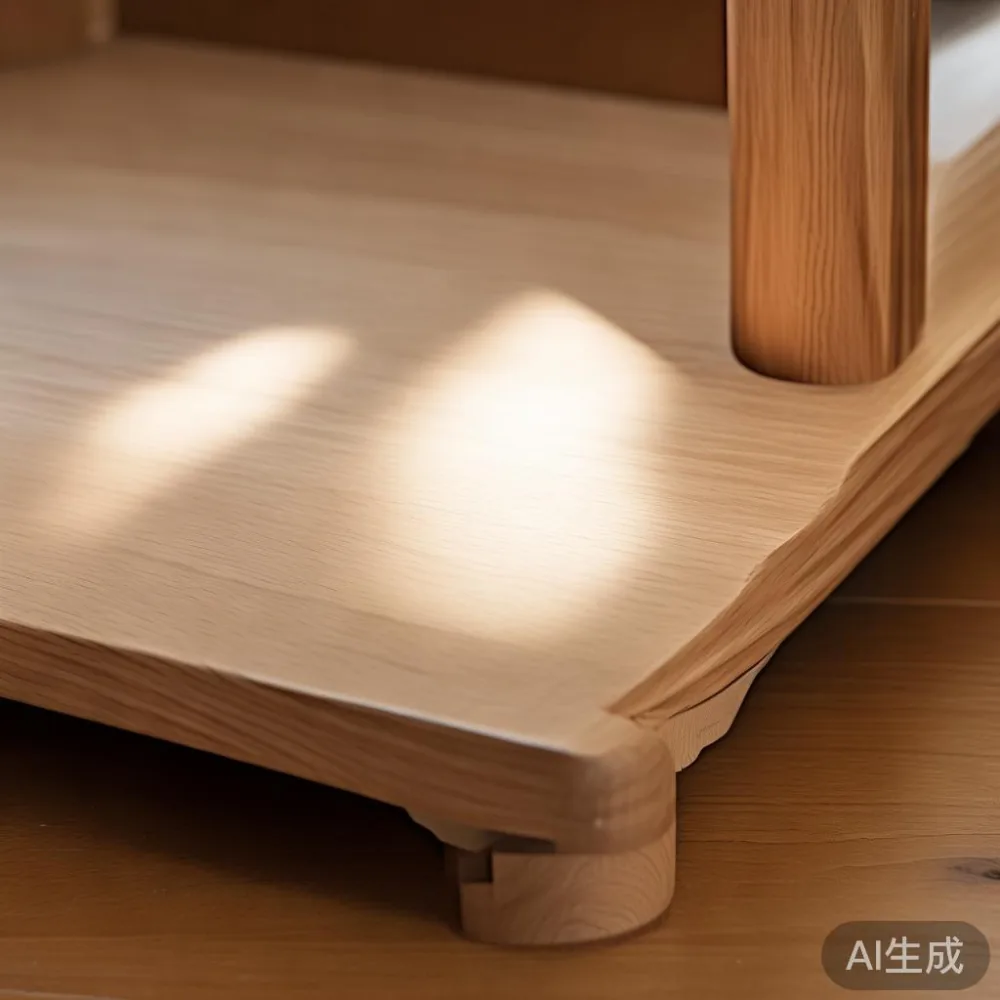
Moisture control is a less visible cost but a highly practical one. Wood should acclimatise to Singapore’s humid conditions before assembly. A manufacturer that controls moisture during drying, machining, and storage reduces later movement, splitting, and joint failure. That controlled process takes time, space, and equipment, yet it contributes to a piece’s long-term performance.
Joinery also separates inexpensive construction from durable furniture. Mortise-and-tenon joints, dowels, bridle joints, and well-fitted fasteners distribute loads differently. In a solid wood sofa or bed frame, the joints must handle movement and repeated use. In a dining table, the joint beneath the top must resist twisting, while the base must remain stable on an uneven floor.
These are practical reasons to examine construction rather than follow broad price stereotypes. The category of French light luxury furniture can carry a premium for silhouette, craftsmanship, and finish, while American light luxury often places value on comfort, material performance, and understated detailing. Post-modern light luxury may use unusual geometry or mixed materials. None of these labels tells you whether the underlying timber is stable or whether the joinery will hold.
How do dimensions and timber thickness affect the price?
Dimensions drive both material use and machining time. A 160 cm dining table using 28 mm solid wood requires substantially more timber than a 120 cm table using 18 mm timber. A 200 cm wardrobe may need longer boards, more vertical partitions, and additional handling. The final weight also affects freight, especially when a delivery crew must carry it through a corridor or install it inside a condo.
For Singapore homes, size should be planned around real access routes. HDB lift doors are commonly around 90 cm wide, although individual blocks vary. A 110 cm dining table top may not pass through a standard door opening if carried vertically, but removing the legs or turning the top diagonally may solve the problem. A bed frame can also enter as separate side rails, headboard, footboard, and slats rather than as one rigid piece.
A supplier who asks for the building type, lift dimensions, corridor turns, and doorway width before dispatch demonstrates logistical competence. Those questions affect packing and delivery method, but they do not automatically mean the furniture is overpriced. They prevent a common source of waste: producing a beautiful piece that cannot reach its destination.
For larger pieces, installation matters too. A 220 cm solid wood dining table may take 45–90 minutes to assemble, while a compact nightstand may take 10–20 minutes. Marble table delivery needs particular care because the stone can weigh 45–90 kg depending on its dimensions and thickness. Upgrading the lifting frame, adding protective wrapping, or scheduling a suitable service window can increase the quoted price, yet it also protects the purchase.
When comparing products, measure the assembled item and the largest packaged component. Check whether shelves, doors, and drawers can be removed. In narrow Punggol or Tampines corridors, modular construction can be worth more than decorative packaging. The aim is a piece that enters safely and remains usable, not simply one that photographs well in a showroom.
Why do finishes, hardware, and joinery change the final cost?
Finish is one of the clearest price variables. A hardwax oil that reveals the open grain may be less expensive to apply than a high-build lacquer system requiring multiple primer, colour, and sanding stages. Lacquer can create a smooth, uniform surface, but it changes the tactile character of solid wood. In japandi style interiors, pale oak with a matte oil finish is often used to keep the material visually quiet and natural.
The number of surfaces also matters. A dining table with an eased edge, shaped corners, and a visible underside takes more sanding than a square-edged top. A wardrobe with inset handles, matched grain, and aligned doors requires careful fitting. A solid wood sofa can combine timber framing with high-resilience foam, fabric or leather upholstery, webbing, springs, and removable covers. The frame may be solid wood while the cushions are not; both facts should be stated plainly.
Hardware should be judged by function and expected load. A bed frame may use centre support legs and slats with appropriate spacing, while a wardrobe may use full-extension runners rated for 25–40 kg per pair. Dining-table runners should be rated for the expected load rather than chosen only for appearance. A marble table may need reinforced brackets and a level base because stone is rigid and unforgiving.
I visited a supplier last month to examine how a team inspected a dining table before packing. The raw top had already been sanded, but the checker still used a straightedge across it and inspected the underside for uneven tool marks. A moisture meter confirmed the reading for the batch. The table then received a final oiling and another surface check. That inspection took about 15 minutes, yet it would have been difficult to reproduce after the table reached a customer’s home.
This is why an image alone cannot establish value. Ask for the timber species, finish type, joint method, hardware specification, and care requirements. For a major purchase, request photographs of the underside and joinery. A maker with a 10-year structural warranty can often explain not only what is covered, but also which construction details support that promise.
Is a solid wood dining table worth its price?
A solid wood dining table can be worth its price when the material, proportions, and construction serve daily life. For a 4-person flat in Bedok, a 140–160 cm table may be more useful than a 200 cm model that restricts circulation. A 180–220 cm table suits larger dining groups but should be checked against lift access and the space required for chairs, serving, and cleaning.
Price comparisons should be like-for-like. Compare the same timber species, top thickness, base design, finish, and warranty. One table may use rubberwood with a walnut stain; another may use genuine walnut with an oil finish. Both may appear brown in a photograph, but they differ in cost, maintenance, and ageing behaviour.
Search terms can also blur categories. A page about 2026 Mid-century modern furniture may show tapered legs, sculptural forms, and mixed timber. A page about under 2000 French provincial furniture may focus on curved edges, decorative mouldings, and traditional silhouettes. Those references are useful for visual direction, but the quotation should still identify measurable specifications.
The European sofa vs Mid-century modern sofa comparison makes a similar point for seating. European forms may use firmer, tailored cushions and visible timber framing; mid-century silhouettes may use slimmer arms, tapered legs, and lower profiles. A solid wood sofa with a supportive frame can cost more because the timber is kiln-dried, the joints are reinforced, and the suspension is specified for repeated daily loading.
For Singapore conditions, buyers should also ask how the finish handles heat, spills, and humidity. A maintenance kit may include an oiling cloth and care instructions. Small marks can often be treated by refinishing rather than replacement, which is why a maker offering lifetime refinishing can reduce the long-term cost of ownership.
How much should a bed frame, wardrobe, or nightstand cost?
There is no single honest price for every solid wood bed frame. A platform frame using 20–25 mm timber, a slatted base, and a straightforward finish may fall within a more accessible budget. A heavier frame with shaped headboard, detailed joinery, and a coordinated finish will cost more. Bed size also changes material use: a queen bed needs longer rails, while a king bed requires a broader centre structure.
For compact HDB bedrooms, the best Scandinavian bed for 2026 should be assessed against available space, not only style. A low-profile frame may measure 210–220 cm long and 90–160 cm wide, depending on the design. In a 9–12 m² room, the gap around the bed can be more valuable than a large headboard. Mattress height should be checked so the user can sit and stand comfortably.
A wardrobe is similarly driven by internal planning. A 150 cm unit with 55–60 cm hanging sections and adjustable shelves may be more expensive than a wider unit with mostly fixed shelving because the hardware and fitting requirements increase. Hinged doors need precise alignment; sliding doors reduce the space required in front but need careful track construction. Flat-pack wardrobes can reduce freight cost, while assembled units may be easier to inspect but harder to move through a lift.
A nightstand can appear minor, but it still reveals construction quality. Look for full drawers, dovetail or dowelled corners, smooth runners, and a rear stop that prevents repeated impacts. A 40–50 cm wide model with one drawer is usually sufficient for a bedside table. Japanese-inspired japandi style versions often use minimal forms, warm oak, and slim profiles, but minimal appearance does not mean minimal construction.
Buyers should consider the GST-inclusive price and what happens if delivery fails or a component is damaged. Clear policies reduce uncertainty. A 14-day return period gives time to assess colour, fit, and condition, while a 10-year structural warranty signals longer-term accountability. The useful question is not whether an item is expensive in isolation, but whether its specifications justify the total paid.
How does delivery affect the price in Singapore?
Delivery is sometimes treated as an afterthought, yet it can be a substantial part of the cost. A compact nightstand may fit inside a van with little extra handling. A 200 cm bed frame or 220 cm dining table may require two delivery staff, a larger vehicle, extra protection, or an installation service. Buildings with stairs, restricted loading windows, or lift reservations can add operational time.
Quotations should specify what is included: doorstep delivery, room-of-choice placement, assembly, packaging removal, and damage inspection. A typical mainland Singapore delivery may take 3–10 days after the piece is ready, depending on stock and production. Made-to-order items can require 4–8 weeks, with the final date confirmed after production. Remote-area or extra-carry charges should be disclosed before payment.
Some retailers absorb freight above a stated threshold. MIDHILL offers free shipping over US$350, which can make a multi-piece order more economical. Because the threshold is expressed in US dollars rather than SGD, customers should check the live conversion and any applicable GST before comparison. A product displayed at SGD 1,600, for example, should be assessed using the final payable SGD amount.
Local service is also part of the proposition. A supplier that has exported to more than 15 countries may have efficient packing practices, but Singapore customers still benefit from clear communication in local time, WhatsApp updates, and a straightforward damage-resolution process. Email enquiries can be sent to midhillco@gmail.com, with the item dimensions and access details included to speed up a quote.
Long-term service matters more than a low freight line. Lifetime refinishing can restore a surface years later, and a 10-year structural warranty addresses the frame or body rather than merely the first 12 months. These provisions do not guarantee that timber will never scratch; they establish a route for maintaining and repairing the piece.
How do I compare two quotes without being misled?
Start with the final, GST-inclusive SGD price. Then place the two products in a specification table covering dimensions, timber species, board thickness, joinery, finish, hardware, warranty, delivery, assembly, and returns. This comparison is more informative than comparing decorative labels or dramatic discount claims.
For a japandi style interior, consider whether the piece balances visual warmth with usable proportions. Light oak can work in a compact Punggol flat because pale tones reflect daylight and reduce visual heaviness. Walnut adds contrast but may make a smaller room feel darker. A marble table can introduce cool texture beside a solid wood dining table, although the combination requires careful control of colour and veining.
Before paying, verify whether the quoted measurements refer to the assembled piece or a flat-packed package. Check the largest door, lift car, and corridor turn. Ask whether the item can be separated into smaller components and whether the delivery crew can carry it to the correct level. If the answer to “how will it reach my dining room?” is unclear, the quotation is incomplete.
Finally, consider repairability. Solid wood can often be sanded and refinished, while veneer may be more difficult to restore after edge damage. Replaceable glides, accessible fasteners, and individually replaceable drawer runners can extend service life. These are cost-saving features over 10 years, even if they do not create a dramatic visual impression on delivery day.
The price of solid wood furniture is driven by a chain of decisions: where the timber comes from, how it is dried and graded, how much material is used, how joints are made, what finish is applied, how the piece is protected in transit, and what support follows purchase. Understanding those variables allows a buyer to pay for demonstrated construction rather than vague prestige. In a Singapore home, that combination of durable materials, disciplined proportions, careful access planning, and credible after-sales care is the true foundation of light-luxury value.